
Assessment report: Fall of a passenger car into the water at Kokkila cable ferry dock on 22 August 2025
Course of events
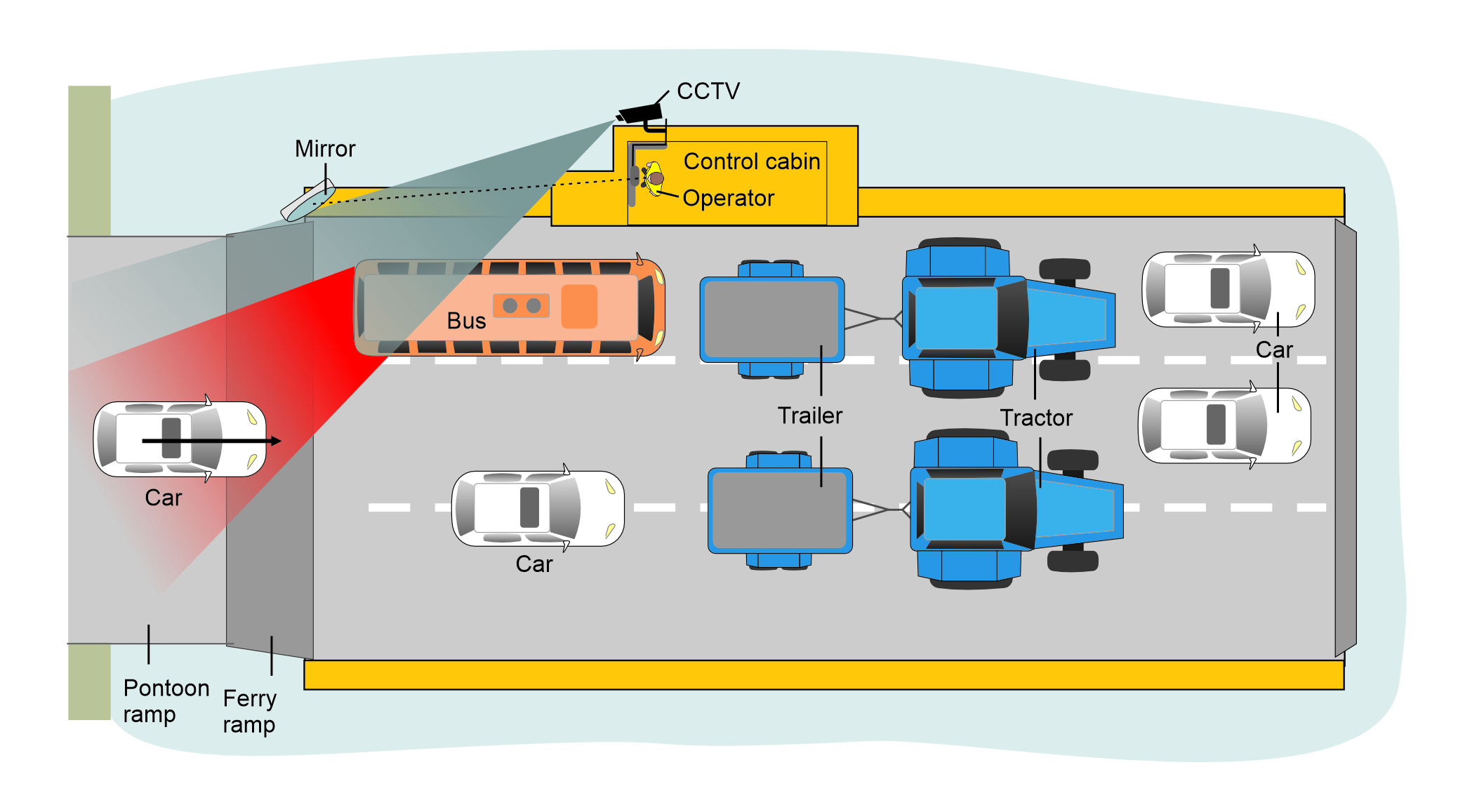
A passenger car fell into the water when the cable ferry left the pier on 22 August 2025 at the Kokkila ferry dock. Before the ferry took off and the accident happened, two tractors with trailers had driven onto the ferry. The ferry driver guided them into their places. Following the tractors, a bus and two cars boarded the ferry. When the ferry driver had returned to the cab, they tried to see if there were any more vehicles behind the bus using a mirror located in the rear corner of the ferry. The driver did not see any cars behind the bus and started preparing for departure. However, one passenger car had managed to drive onto the ferry behind the bus, and yet another passenger car behind it had reached the loading ramp leading to the ferry. The driver of the last car that had managed to drive onto the ferry stopped at this point for a little while as they discovered that the passenger car ahead had driven into the middle of two lanes.
In the cab, the ferry driver checked one last time the screen of the deck surveillance camera placed on the cab roof that no other cars were coming aboard. Then he lowered the boom barrier located on the loading ramp. The driver of the car noticed that the ferry boom came down behind them but assumed that the ferry driver had estimated that the car would still fit aboard before the ferry started off. At the same time, the ferry driver started lifting the ferry ramp. Lifting the ferry ramp also pulls of the ferry from the loading ramp. The edge of the rising ramp stuck to the car behind the front tyres and briefly lifted the front end of the vehicle into the air.
When the car driver found that their car started to rise up with the ramp, they realised that the car would fall into the sea. They unfastened their seatbelt and opened the car door to jump into the sea. However, the ferry ramp prevented the door from opening properly. The car fell into the water and remained floating horizontally on the sea surface for a while. Water began to flood into the car through an open door and the car floor. Despite the resistance of the flowing water, the driver managed to push the door open and exit the vehicle. The driver remained next to the ferry dock for a moment to find a suitable spot to safely swim under the ferry cable and get out of the water.
One of the ferry passengers went to inform the ferry driver that a car had fallen into the sea. The ferry driver changed the direction of the ferry back to the starting point and reported the incident to the Maritime Rescue Coordination Centre on the VHF channel. At the same time, he saw that the driver was swimming to the shore. The ferry driver steered the ferry back to the Kokkila ferry dock. He went onto the deck to ask the driver who had swam ashore if there were any other passengers in the car. Once the ferry driver had received a negative answer and found that the driver was all right, he took the vehicles on board to the Kokkila ferry dock. The driver of the car that had fallen into the sea called the emergency response centre themselves after a person on the shore lent them a phone. The rescue department’s ambulance and rescue units as well as the police visited the scene of the accident. Both the ferry driver and the car driver were given a breathalyser test.
The passenger car sank at about five metres from the ferry dock. The driver sustained some bruises and a minor strain injury as a result of the fall. The car was lifted from the sea on the evening of the day of the incident, and the ferry was able to continue normal operation after that.
Background information
There are about 40 road ferry routes in Finland. Of these, 32 are short ferry connections, such as the ferry route between Kokkila and the island of Kimito, which is operated by Suomen lauttaliikenne - Finferries. In Finland, a road ferry connection may be the only connection between the mainland and an island, which makes such connections a critical part of the transport network. From Kokkila, Kimito can be reached by bridge, but the route has also a ferry service. However, since there is a bridge connection to Kimito, the Kokkila ferry can occasionally be used as a replacement ferry on other road ferry routes. When the accident happened, the Kokkila ferry route was served by an older ferry used as a spare, which is smaller in size than the regular ferry. The spare ferry has only one surveillance camera on the roof of the cab, while the regular one has another camera placed on the opposite side of the ferry. The cab of the regular ferry is also placed higher, which means that not even large vehicles block the visibility in the same way. The regular ferry also has traffic lights for vehicles boarding the ferry from the shore.
As a rule, ferries in Finland have one driver only, even though it has been generally recognised that the practice of using a single driver increases the risks to the safety of both the driver and the ferry. Efforts are being made to reduce these risks by means of technical solutions, such as a steering cable, duplication of systems and traffic lights. Mirrors and cameras also aim to improve the driver’s ability to observe vehicles and passengers.
The Centre for Economic Development, Transport and the Environment (ELY Centre) for Southwest Finland is responsible for organising the road ferry traffic nationwide. The ELY Centre usually puts each transport connection out to tender separately for a fixed period of time. Suomen lauttaliikenne – Finferries is a State-owned service provider responsible for the majority of ferry and road ferry connections in Finland. At the ferry dock, the boarding ramp belongs to the service provider and the road leading to it to the local ELY Centre. The boom barrier and potential traffic lights are the responsibility of Finferries. The Finnish Transport and Communications Agency supervises the maritime safety of ferries and road ferries, including the legality of rescue equipment. As the customer, the ELY Centre monitors the safety of the service provider’s operations.
General instructions have been issued on how to load a ferry. However, in practice ferries carry a wide variety of different types of cargo, such as agricultural machinery and lorries. Due to the general nature of the instructions, the driver must load the ferry based on their personal experience.
It is rare for a car to fall into the water in Finland. However, this is a dangerous type of accident. The survival of those in the car depends on the actions taken during the first few minutes of the incident. From the perspective of safety, this is a situation where a normal traffic environment suddenly becomes life-threatening. When this happens, the correct course of action is often more decisive than external assistance. According to studies, passengers must exit the vehicle immediately when it is still floating: they must unbuckle their seat belts, open a window, get children out and exit immediately. Some rescue departments have practised rescue from submerged vehicles, because it is a challenging task and the visibility is often poor. People living in archipelago areas and near water bodies are usually well aware of the above-mentioned principles of saving themselves, but the wider population is inadequately informed about them.
Observations
The ferry driver cannot necessarily see that there are cars or passengers on the ramp without going on the deck to check the situation.
When changing from one ferry to another, one may not recognise the changed risk factors, such as the insufficient visibility from the cab of older and smaller ferries. Taking such risk factors into account is a key part of ferry traffic operations.
Exiting a car in the water has been generally identified as a hazardous situation. Especially people living in archipelago areas and near water bodies are usually well aware of the correct principles of saving themselves, but the wider population is inadequately informed about them.
The assessment found that a safety investigation conducted by the Safety Investigation Authority would not provide significant additional information that would lead to substantial safety improvements. The Safety Investigation Authority, Finland (SIAF) will not initiate a safety investigation into the incident.
Inquiries:
Interim Chief Safety Investigator Ilkka Kervinen, tel. +358 (0)2951 50750
Published 21.11.2025