
Report on Investigation into grounding of inland passenger vessel Silver Moon on lake Pyhäjärvi on 24 November2023
15.01.2024
24.11.2023
15.01.2024
Marine (M)
Accident
DESCRIPTION OF THE INCIDENT
The passenger catamaran Silver Moon, which is operated by Suomen Hopealinja Oy, cast off for a private charter cruise at 6 pm on 24 November 2023. The vessel was carrying approximately one hundred passengers and seven crew. The itinerary was for a three-hour cruise on Lake Pyhäjärvi. At the mid-way point, the vessel passed under the bridges that span the Rajasalmi Strait, turned around and headed back towards its moorings at Laukontori Square along the southern lane.
The conditions for the cruise were challenging. It was dark, and snow was falling heavily at times. There was also a strong north-easterly wind. Due to the conditions, the shipping company had called in an additional master capable of assisting the crew.
The accident occurred after the mid-way point of the cruise, when the vessel drifted south of the route. There is a submerged rock at the tip of Virkaniemi Cape, which is marked on nautical charts. On the evening in question, the master was navigating visually and relied on landmarks and a chart plotter. He used a searchlight to make out navigation marks. He was not using radar. There were two lookouts in the pilothouse at the time of the accident, of whom one had master capability. The lookouts were primarily tasked to look out for fishing gear markers.
The master noticed that the wind was pushing the vessel off course to the right and made several attempts to correct the vessel’s course but did nothing to change its speed. Neither the master nor the lookouts noticed the north cardinal mark on the north side of Virkaniemi Cape before the vessel ran aground. After the grounding, the deckhands who had acted as lookouts inspected the vessel for leaks. No leaks were found. Once this had been confirmed, one of the lookouts called emergency services and reported the accident. The report made it clear that the vessel was not at risk of sinking and that no one had been injured. The emergency dispatcher alerted the Pirkanmaa rescue department.
The rescue department sent its only rescue boat equipped with a cabin that was still in the water to attend the scene. The cold weather, wind and darkness made the evacuation of passengers difficult. Moreover, the cruise was for an office Christmas party, which was reflected in the passengers’ clothing. The rescue department’s boat was only big enough for ten passengers at a time, which made the evacuation a relatively slow process. The boat had to make multiple trips back and forth between the stricken vessel and the marina in Turri. Coaches were provided to take the passengers from the marina to the centre of Tampere. The shipping company decided, for safety reasons, to replace the vessel’s crew for its journey back to the moorings at Laukontori Square.
Olyckan inträffade under resans andra hälft, efter att fartyget hade hamnat vid farledens södra del. Vid Virkaniemi udde finns en sten under ytan, vilken har märkts ut på sjökortet. På olyckskvällen navigerade befälhavaren visuellt utgående från landmärken och använde kartplottern som hjälp. Befälhavaren använde strålkastare för att lokalisera landmärken. Befälhavaren använde inte radar som stöd för navigeringen. Vid olyckstidpunkten befann sig två utkiker i styrhytten, av vilka den ena var en person med befälsbehörighet. Utkikerna hade i synnerhet till uppgift att försöka upptäcka nätmärken.
Befälhavaren upptäckte att fartyget drev mot höger i färdriktningen på grund av vindens inverkan och försökte korrigera kursen åtskilliga gånger, men justerade inte fartygets hastighet. Varken befälhavaren eller utkikerna upptäckte dock nordprick norr om Virkaniemi innan fartyget körde på grund. Efter grundstötningen kontrollerade däcksmännen som fungerat som utkiker fartyget för läckage. Inga läckage upptäcktes under kontrollen. Efter att detta säkerställts ringde den ena utkiken nödcentralen och larmade om en sjöolycka. I larmet framkom att fartyget inte riskerade att sjunka och att inga människor hade skadats. Nödcentralen gav räddningsuppdraget till räddningsverket i Birkaland.
Räddningsverket i Birkaland larmade sitt enda täckta fartyg som ännu var i vattnet till uppdraget. Det kalla vädret, vinden och mörkret försvårade evakueringen av passagerare. Dessutom befann sig de evakuerade på en julfestkryssning, vilket påverkade deras klädsel. Räddningsverkets båt hade rum för tio passagerare åt gången. Därför gick evakueringen ganska långsamt, eftersom båten måste köra många gånger fram och tillbaka mellan fartyget och småbåtshamnen i Turri. Från Turri transporterades passagerarna med bussar till Tammerfors centrum. Av säkerhetsskäl beslutade rederiet att byta ut fartygets besättning för flytten av fartyget till kajen vid Laukontori.
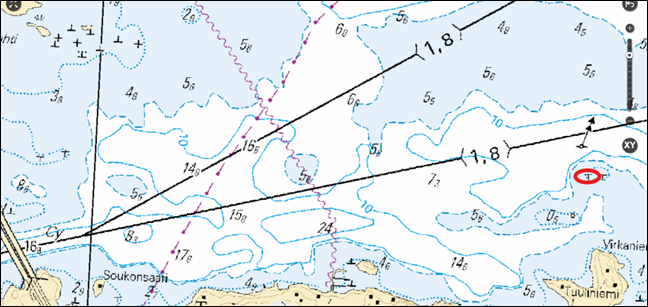
Accident site. The shallows where Silver Moon ran aground are shown in red. (Image: Suomi.fi maps, notations by SIAF)
BACKGROUND
Suomen Hopealinja Oy is Finland’s largest operator of inland passenger ships with more than 100,000 passengers each year on Lake Näsijärvi and Lake Pyhäjärvi. The company is owned by the City of Tampere. It has a total of six vessels and employs approximately twenty staff on a seasonal basis. Hopealinja vessels operate on Lake Pyhäjärvi until the lake freezes over.
Silver Moon is a passenger vessel with a catamaran hull, built in 1996. It has a maximum passenger capacity of 200. The vessel’s displacement is 157. The crew usually consists of a master and a deckhand as well as an appropriate number of service personnel. All crew have been trained to perform special duties, such as evacuation, in an emergency.
Lake Pyhäjärvi is not an easy water area to navigate. Vessels are generally expected to operate under visual navigation rules, and the navigation safety equipment used on the lake mostly consists of sector lights, lateral and cardinal marks as well as cairns.
The Pirkanmaa rescue department is well equipped to deal with waterborne emergencies in the summer. The length of the boating season depends largely on weather conditions. Icy slipways in late autumn in particular make it difficult to recover boats using the rescue department’s own equipment, which is why boats are often taken out of the water before lakes freeze. There is no procedure for regular communication between the commercial operators on the lakes and the rescue department when it comes to safety towards the end of the boating season.
The Pirkanmaa Maritime Rescue Association is a local branch of the Finnish Lifeboat Association, which patrols Lake Näsijärvi and Lake Pyhäjärvi during the boating season. The patrolling usually ends at the end of October. There is no procedure for regular communication between the commercial operators on the lakes and the Finnish Lifeboat Association when it comes to safety towards the end of the boating season.
The most important safety document for merchant shipping operators is their Safety Management System (SMS). Finland no longer requires an SMS from shipping companies that only operate in domestic waters. The Finnish Transport and Communications Agency only carries out an annual inspection of the fleet’s technical soundness and maritime rescue equipment.
The Finnish Border Guard has published a set of emergency action cards for passenger vessels operating domestically.
OBSERVATIONS
The accident was caused in part by lack of coordination between bridge crew members and the choice of navigation method. The master failed to communicate actively with other crew members or to give them tasks to support navigation, such as the use of radar, which would have been helpful in the circumstances.
The shipping company’s decision to add a second crew member with master capability was made to improve safety. However, the SMS did not support interaction and teamwork between crew members on the accident journey.
It would have been better from the perspective of maritime safety if the rescue department and emergency services had been aware that there was a commercial operator in the Pirkanmaa area so late in the year.
The shipping company had an SMS, but the impact of late-season weather conditions on safety had not been given special attention in the procedures. The regulations governing domestic shipping say nothing about the contents of SMSs. Safety procedures are also not covered by the Finnish Transport and Communications Agency’s inspections.
The Safety Investigation Authority, Finland has decided not to open a safety investigation into this case but would like to stress the importance of the following:
- The need for better collaboration between operators and organisations that contribute to maritime search and rescue.
- The role that efficient teamwork on the bridge plays in ensuring safe navigation in all circumstances.
- Taking into account the impact of the features of the area in which the vessel operates in SMSs and especially in plans and procedures relating to evacuation.