
Investigation process
The investigation of accidents and dangerous situations proceeds according to the same principles regardless of the situation.
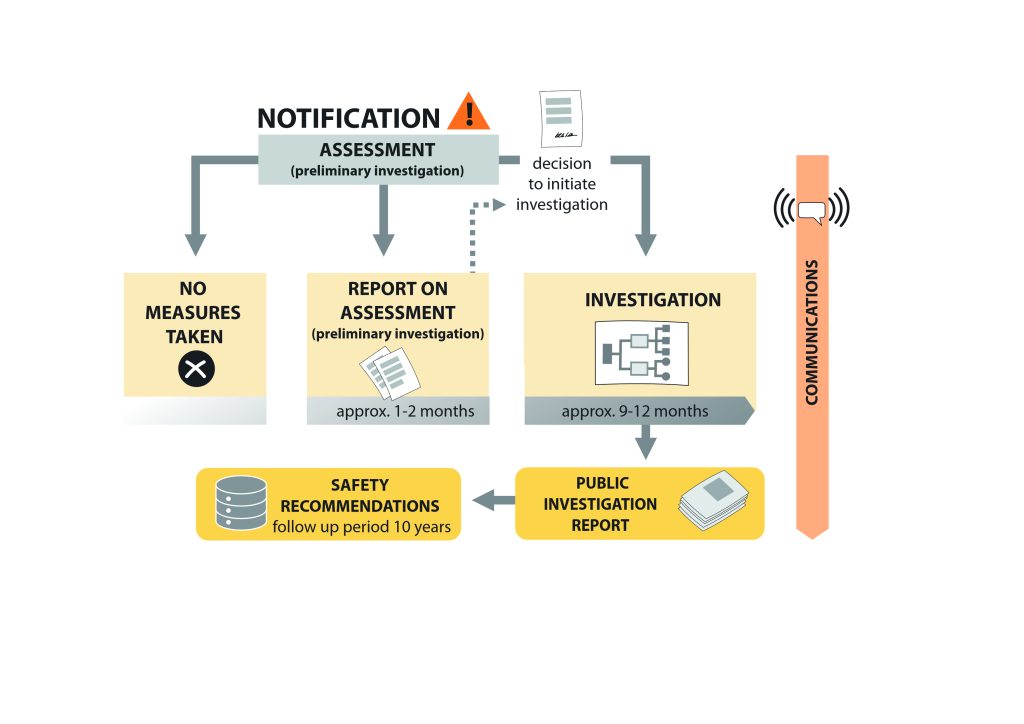
Notification of an accident
We receive weekly notifications of accidents from other authorities and actors in various fields. Notifications may come, for example, through the emergency response centre, a supervisory authority, or a private operator. Information about the accident is forwarded to the lead investigator, who begins to clarify what has happened and forms an overall picture of the situation.
As the overall picture develops, we gain an understanding of the necessary measures. Sometimes it is quickly clear that a thorough on‑site investigation is needed, while at other times a few phone calls are enough to determine that a safety investigation would not provide any benefit for general safety.
Initiating an investigation
After the initial clarification work and any possible on‑site investigation, it becomes clearer whether there are grounds to initiate a safety investigation. We assess whether safety has been taken into account sufficiently and whether a safety investigation would provide a benefit for general safety. As an independent and impartial authority, we make the investigation decision based on our own assessment. We do not initiate a safety investigation to assign legal responsibility, nor do we take a position on liability or compensation issues.
Stages of the investigation
In the investigation decision, we appoint an investigation team, which typically consists of 3–5 accident investigators. The investigation leader is always one of the Safety Investigation Authority’s lead investigators. An OTKES specialist investigator is often part of the team either as the team leader or as a member. The other investigators are experts trained by us. We assemble the investigation team from suitable experts from different fields to ensure the necessary competence and a sufficiently broad perspective.
During the first months of the investigation, we interview those involved in the accident, collect information through on‑site investigation and information requests from other authorities. If necessary, we conduct tests or simulations. We do not disclose the information obtained to third parties or other authorities. With a sufficient amount of information, we determine the probable course of events and, through careful analysis, form conclusions about the factors that influenced the accident.
Before publication, we send the investigation report for comments to those involved in the accident and to the authorities responsible for supervision in the relevant field. We take the comments into account when finalising the report. The completed investigation report is translated into different languages as needed before publication. In total, a safety investigation takes 9–12 months.
Recommendations
Providing recommendations is one of our most important tools for improving general safety. The content and targeting of the recommendations are carefully planned, and we also discuss the recommendations in advance with the parties who will receive them. We monitor the implementation of our recommendations for ten years.
Preliminary report
The published preliminary report describes the course of events and the observations made, but it does not contain conclusions or recommendations and is not as comprehensive as a full safety investigation. The purpose of the preliminary work is to assess the need for a safety investigation and the potential benefit for general safety. Often we identify the need for a safety investigation quickly, but sometimes the assessment requires a few weeks of more detailed clarification work. In the published preliminary report, we may present observations to improve general safety even if we do not decide to initiate a safety investigation. Publishing the preliminary report usually takes one to two months.