We use cookies on this website to provide the service and enable statistics. You can accept all cookies or continue using only the necessary cookies.
Information about webpage
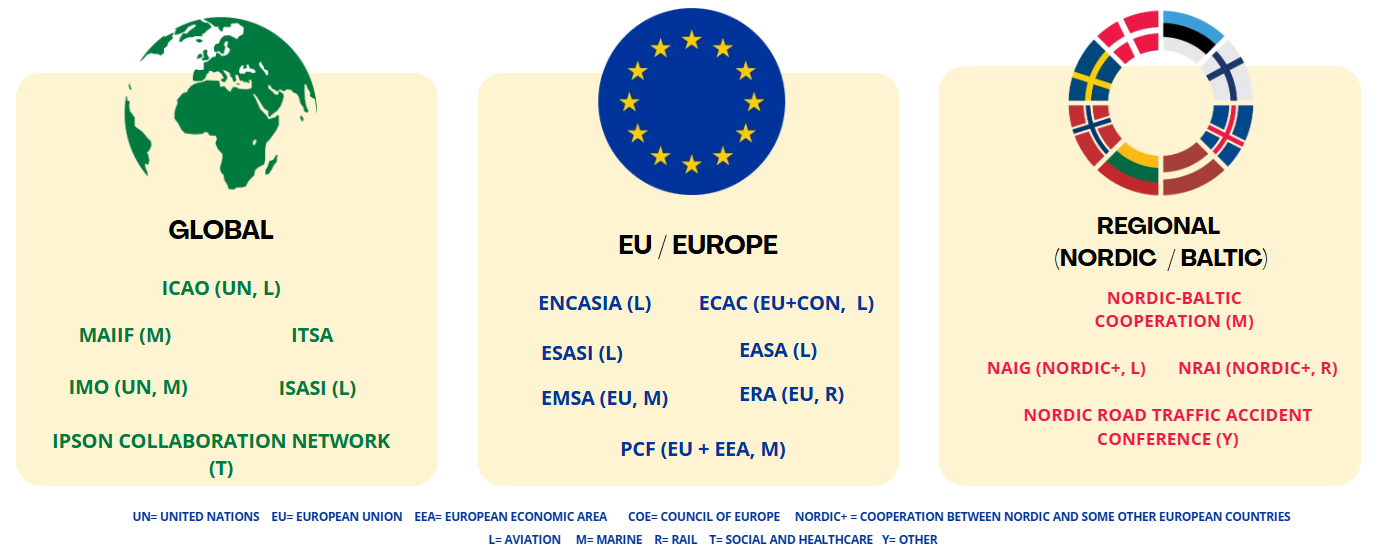
The Safety Investigation Authority’s (SIAF) international activities are diverse and multi-leveled varying from global to regional – both Europe-wide and Nordic-Baltic. The SIAF collaborates with its counterpart in other countries within the realms of investigations when required or necessary.
In the field of transportation in particular, there is internationally binding legislation that applies to the entire sector. Activities subject to international regulation require cooperation at many different levels. The common goal is to promote safety and prevent accidents. To this end, officials from the Accident Investigation Board participate in meetings where, for example, work is done to revise directives, prepare for international audits or peer reviews, train investigators, or develop new guidelines and joint documents on various aspects of safety investigation, such as the involvement of bereaved families.
The safety recommendations put forward by SIAF are sometimes also directed at international actors. In such cases, from the perspective of public safety, it is beneficial—if not essential—to engage in dialogue with the entity to which the recommendations are addressed. The intention, after all, is that the recommendations is implemented.
Completing a safety investigation may require international cooperation
If foreign nationals are involved in the accident or incident under investigation, or if, for example, the country of manufacture or registration of an aircraft or its components is other than Finland, representatives from other sister agencies may be appointed to the investigation—as experts or authorized representatives. International cooperation also enables technical assistance, for example, in the analysis of aircraft recorders such as the CVR (cockpit voice recorder) or FDR (flight data recorder). Finland does not have a laboratory capable of analyzing these recorders for example.
The international cooperation carried out in various investigative branches and its objectives are described below.
ICAO – International Civil Aviation Organization
The International Civil Aviation Organization (ICAO) is a United Nations agency which, among other things, sets standards to ensure aviation safety and efficiency in civil aviation. ICAO is the highest “decision-making body” in global aviation.
EASA – European Union Aviation Safety Agency
EASA is the European ICAO. EASA’s jurisdiction covers European countries. EASA also develops standards and aviation regulations that serve as the basis for national aviation legislation.
Once a year, EASA organizes the EASA–CASIA meeting at its headquarters in Cologne, where European aviation safety investigation authorities gather to hear about EASA’s new development projects and to present findings from their investigations that have led to recommendations for EASA.
ENCASIA – European Network of Civil Aviation Safety Investigation Authorities
ENCASIA is a network that brings together all civil aviation safety investigation authorities operating in Europe. ENCASIA establishes common guidelines on how aviation investigations are conducted, how to facilitate cooperation among European countries, and shares lessons learned from investigations across different countries. ENCASIA holds a plenary meeting twice a year in Brussels, where these administrative matters are decided.
ECAC – European Civil Aviation Conference
ECAC is an intergovernmental organization whose goal is to harmonize aviation practices among different European countries and to promote safe, efficient, and sustainable aviation in Europe.
ECAC organizes a meeting called the ACC (Air Accident and Incident Investigation Group of Experts) twice a year. Representatives from all European aviation safety investigation authorities attend the meeting. In addition, representatives from aviation companies—such as aircraft manufacturers, operators, and others—attend the meetings. The meetings serve as a forum for sharing information on new developments in aviation and lessons learned from recent accidents. The host country rotates with each meeting, so the conference travels around Europe.
NAIG – Nordic Air Accident Investigation Group
NAIG is an association of aviation safety investigation authorities that conduct investigations in the Nordic countries—or, more accurately, in northern conditions. Its members include Finland, Sweden, Norway, Iceland, Denmark, and Canada.
NAIG holds an annual meeting attended by several representatives from each country. The host country rotates annually, so the meeting is held in Finland on average every six years. The purpose of the meeting is to strengthen Nordic cooperation in aviation investigations and to present lessons learned from investigations as well as future trends in aviation for which it would be wise to prepare.
ISASI – International Society of Air Safety Investigators
A global, nonprofit organization whose goal is to improve aviation safety through the exchange of knowledge and experience. ISASI organizes conferences to which safety investigation authorities, industry representatives, academics, and legislators—that is, participants from all sectors affecting aviation safety—are invited. SIAF has generally not participated in ISASI meetings.
ESASI – European Society of Air Safety Investigators
ESASI is the European regional chapter of ISASI that carries out the same work ISASI, but on European level. ESASI organizes a major annual conference attended by stakeholders in aviation safety from around the world. The venue for the conference changes each year.
Nordic-Baltic Regional Cooperation
The SIAF cooperates with other coastal state sister organizations in the Baltic Sea area. The cooperation began in 2017, and its operating models are still evolving. The regional network strengthens the exchange of information and communication and supports the coordination of investigative activities in the Baltic Sea area.
EU/EEA Cooperation
Cooperation at the EU and EEA levels regarding maritime accident investigations takes place primarily within the framework of the PCF (Permanent Cooperation Framework) cooperation forum. This cooperation focuses in particular on coordinating tasks under the Maritime Accident Investigation Directive and ensuring the uniform implementation of the directive across Europe.
Global Level
SIAF participates in global cooperation among maritime accident investigators through the MAIIF network (International Maritime Accident and Incident Investigation Forum). At the European level, EMAIIF (European MAIIF) operates as the European chapter of MAIIF.
Global cooperation focuses on addressing practical issues related to maritime accidents, learning from investigative activities, and sharing best practices. The network offers a significant opportunity for international networking and opens doors to the development of bilateral cooperation, which is particularly important in initiating maritime accident investigations and in the actual investigative work.
Under the auspices of the European Railway Agency (ERA), the NIB network—comprising the national railway accident investigation authorities of EU member states, the United Kingdom, Norway, and Switzerland—holds meetings attended by 1–3 representatives from each country.
Meetings are held three times a year.
Topics discussed at the meetings include investigations and the sharing of lessons learned regarding the investigation process.
The network serves as a link between the investigation authorities and the ERA and promotes the common interests of the investigation authorities within the EU.
The network’s working groups develop joint guidelines for the agencies.
The network conducts peer reviews to help the agencies improve their operations (SIAF was reviewed on November 14–15, 2023).
Nordic railway accident investigators meet once a year at the NRAI conference.
In addition to the Nordic countries, Estonia, Ireland, the United Kingdom, and Greece participate in the conference.
The conference is traditionally held in April or May.
In addition to international cooperation in various areas of investigation, the Safety Investigation Authority participates in the activities of the International Transportation Safety Association (ITSA), a network of senior officials from independent safety investigation authorities.
ITSA was founded in 1993 with the idea of serving as an international network that brings together the leadership of safety investigation authorities from many countries. ITSA was intended to be a forum for sharing safety information that would benefit all parties—without creating a structure that duplicates existing safety cooperation efforts. Today, ITSA consists of independent security investigation authorities from 16 countries and meets once a year in the country holding the chairmanship.
SIAF currently serves as the Secretariat for ITSA.
ITSA’s mission is to improve public safety in each member country by learning from the experiences of other countries.