
History
A brief history of accident investigation in Finland
- The investigation of aviation accidents began in the early 1970s.
- The Planning Commission for Major Accident Investigation started its work in 1986.
- The Safety Investigation Authority began its operations on 1 March 1996 (investigation of major accidents and their dangerous situations, as well as aviation, rail, and maritime accidents and their dangerous situations from 1 March 1997 onward).
- Accident investigation and related international obligations were incorporated into the new Safety Investigation Act (525/2011). Investigation boards were replaced by investigation teams, and the investigation of exceptional events was added.
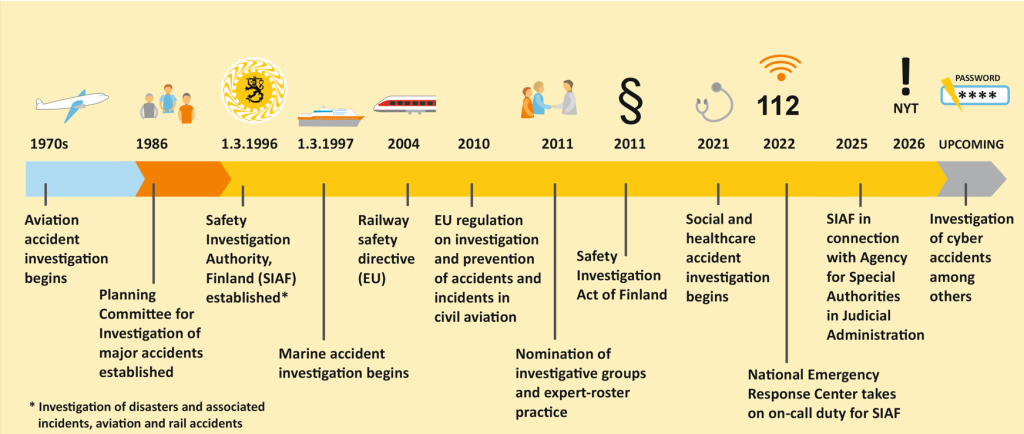
Significant advances were made in the development of occupational safety and in safety investigation during the 20th century. The need for specialised accident investigation arose as a result of major accidents caused by steam engines. Working conditions had been dangerous after the Industrial Revolution, which began in the 18th century; machines were unprotected, the lighting in workspaces was poor, and workers did not have proper protective equipment. In the 20th century, working conditions in industry began to be systematically examined. Pilot errors also began to be studied more closely in aviation in the 1920s. In Finland, descriptions referring to accident investigation can also be found from the 1920s. During the Continuation War in the 1940s, for example, double‑loading incidents involving heavy mortars were investigated, as these had resulted in the deaths of soldiers. The investigation of aviation accidents in Finland began in the 1970s.
Modern safety investigation examines the system‑level factors behind so‑called human error and immediate causes, such as the interaction between the user and the equipment, working practices, the organisation’s safety management, and the actions of supervisory authorities.
The time before the Safety Investigation Authority
The impetus for major accident investigation began with the sinking of the dredger Nostaja on 6 September 1972 off the coast of Pietarsaari. In the accident, the dredger owned by the Finnish National Board of Roads and Waterways capsized and sank, and 16 crew members died. The Ministry of Trade and Industry appointed an investigation board to determine the causes of the accident.
There was no uniform legislation on the investigation of major accidents at the time of the sinking of Nostaja. As a consequence of the event, the Ministry of Justice appointed a working group on 13 September 1972 to prepare a report on how major accident investigation should be organised. The working group’s proposal was completed in autumn 1974, and it recommended that the key principles of major accident investigation should be laid down by law. The objective of the investigation was defined as increasing general safety and preventing accidents. It was proposed that the investigation board be placed under the Government, justified by the need for independence.
Most of the organisations giving statements reacted positively to the working group’s report, but it also received criticism: centralising the investigation of all major accidents under a single central organisation was considered inappropriate. This was justified, among other things, by the fact that some specialised fields already had their own highly developed investigation arrangements. The Prime Minister’s Office did not support placing the investigation boards administratively under it, but instead proposed the Ministry of the Interior as the appropriate location.
The working group’s proposal did not lead to legislative changes, and in 1976 the Constitutional Law Committee addressed the matter in its report: “In connection with the sinking of the dredger Nostaja and the investigation of certain earlier major accidents, it has become evident that the existing regulations and guidelines are insufficient, and that new legislation on the investigation of major accidents is urgently needed in our country.” The Committee believed that legislation was being prepared in the Ministry of Justice and emphasised the necessity of enacting legislation on major accident investigation without delay, requiring that the necessary preparatory measures be carried out immediately.
The Act on the Investigation of Major Accidents was not enacted at this stage. The Constitutional Law Committee again raised the issue in its 1978 report, noting that Finland lacked sufficient uniformity in the investigation of major accidents. According to the Committee, accident investigation was carried out on the basis of legislation in different fields, internal instructions of authorities, and arrangements agreed upon by various organisations. Over time, needs had created separate investigation systems with differing objectives. The Committee required that the preparatory measures initiated in 1972 to enact legislation on major accident investigation be completed without delay.
In spring 1979, the Ministry of Justice appointed a working group to prepare the necessary legislative proposals on major accident investigation. The working group’s proposal was completed in 1981 and was largely based on the 1974 proposal. It led to a Government proposal to Parliament in 1984 for an Act on the Investigation of Major Accidents and amendments to the Aviation Act and section 259 of the Maritime Act. Parliament approved the Act on the Investigation of Major Accidents on 3 May 1985, and it entered into force on 1 January 1986.
Between 1972 and 1985, accidents and dangerous situations were investigated by an investigation board or equivalent body appointed separately for each case by the Government or an individual ministry.
The Act on the Investigation of Major Accidents established a stable accident investigation system. From 1986 onward, major accidents were investigated by an investigation board appointed by the Government. A board was appointed separately for each major accident. In addition, between 1986 and 1995, the Planning Commission for Major Accident Investigation operated under the Ministry of Justice, appointed by the Government for three years at a time. The Commission consisted of experts from various fields familiar with accident investigation, and its task was to initiate preliminary investigations when necessary until an investigation board was appointed.
Members of the investigation board were lay members, except for the secretary, until 1990. From 1990 onward, the full‑time chair of the Planning Commission was lawyer Kari Lehtola, who had participated in the 1979 working group preparing the legislative proposals. The Commission built an expert reserve for investigations and organised major accident investigation courses for its experts.
The investigation of the M/S Estonia disaster (1994–1997) played a significant role in the work of the Planning Commission and in the development of accident investigation. The sinking of Estonia was one of the largest peacetime maritime disasters in 20th‑century Europe. The investigation was conducted by a joint commission appointed by the prime ministers of three states, chaired by a representative of Estonia, the flag state.
At that time, there were no international regulations on accident investigation; the investigation was carried out according to the legislation of Sweden and Finland.
The era of the Safety Investigation Authority and safety investigation
In 1990, the Parliamentary Ombudsman expressed in a letter to the Government the need to transfer the investigation of aviation accidents outside the Civil Aviation Administration to ensure independence. The Government‑appointed investigation board had already investigated some aviation accidents after 1986. Action was taken later when EU Directive 94/56/EY required that aviation accident investigation be carried out by a permanent, independent investigation authority. This requirement initiated legislative changes, and in 1994 the Government submitted a proposal to Parliament to amend the Aviation Act and the Act on the Investigation of Major Accidents. The law was approved on 3 May 1995, and its title was changed to the Act on Accident Investigation. The law also established the Safety Investigation Authority. The Planning Commission for Major Accident Investigation was abolished on 1 March 1996 when the Safety Investigation Authority began its operations.
The investigation of aviation accidents was transferred from the Civil Aviation Administration to the Safety Investigation Authority, and two investigators from the Administration transferred to its service on 1 March 1996. The investigation of railway accidents was also transferred from the Finnish Rail Administration to the Safety Investigation Authority for the same reasons: independence and impartiality.
The Safety Investigation Authority became an agency under the Ministry of Justice, ensuring independence and autonomy. Kari Lehtola, former chair of the Planning Commission, became its first director. The investigation of maritime accidents (excluding boating) was transferred to the Safety Investigation Authority on 1 March 1997 for the same reasons as aviation and railway accident investigations.
In 2008, a special act was enacted on the investigation of certain fatal events, covering the Jokela and Kauhajoki school shootings. The Government appointed investigation boards under the Ministry of Justice to investigate the events. The investigation also had to examine psychosocial factors and the influence of the media and computer games.
In 2011, the Safety Investigation Act, entered into force, repealing the Act on Accident Investigation. The main reasons for the new law included updating the legislation and harmonising it with the new Constitution. The changes also ensured that national regulations were consistent with international obligations.
Safety investigation is a new concept emphasising both the objectives of the investigation and its independence from other inquiries or reviews that may take place after an accident. The term has also become established in international agreements and the latest EU legislation.
With the new law, investigation boards were abolished. The Safety Investigation Authority appoints an investigation team for each case. The law allows the use of external experts in investigation teams, as well as special experts.
Under the Safety Investigation Act, an exceptional event that is not an accident may also be investigated. Previously, a separate act had been required for such investigations (e.g., the Jokela and Kauhajoki school shootings). The decision to initiate an investigation of an exceptional event is always made by the Government. A 2019 amendment to the Act clarified OTKES’s powers and transferred the appointment of investigation teams for exceptional events from the Ministry of Justice to the Safety Investigation Authority.
Today, the Safety Investigation Authority investigates accidents and serious incidents in five branches: aviation, maritime, rail, other accidents, and social and health care. Only a few countries have a safety investigation authority that investigates both other accidents and social and health care incidents. The Safety Investigation Authority relies on trained external experts, enabling operations with a relatively small permanent staff. The Authority has its own training system for experts and staff.