
Ms. Tiina Bieber
Head of Public Affairs
0295 150 714
firstname.lastname@om.fi
In civil aviation, assistance to victims of aircraft accidents and their loved ones is defined as the ability to provide information, resources, and services. International regulations also require countries to enact laws and implement them to support victims of aircraft accidents and their loved ones.
Assistance intended to support victims of aviation accidents and their loved ones requires collaborative planning and response from many different parties, such as the air carrier, the airport operator, the country where the incident occurred, the victims’ countries of residence, non-governmental organizations, and commercial enterprises.
The support framework developed in civil aviation also serves as a solid guiding principle for developing assistance and services provided to victims and their loved ones.
Any accident is unexpected and, in many ways, a serious event for those involved and their loved ones. Assisting victims and their loved ones is the responsibility of both the authorities and other organizations involved.
Providing appropriate assistance helps mitigate the consequences of accidents and incidents and improves societal resilience: Proactive planning, for example, helps manage and potentially reduce the need for long-term care—and thus maintain functional capability of the society as a whole.
The family assistance framework, developed to help victims and their loved ones, helps strengthen the government’s overall emergency preparedness and enables the government to respond more effectively to a wide range of disasters. The quality and reliability of the emergency assistance system directly impact the government’s reputation. Assisting victims and their loved ones also bolsters confidence in the actions of the State and its authorities.
As for safety investigation authorities, they can, through independent and impartial investigations, help in preventing future accidents and incidents through lessons learned – and thus contribute to the State’s reputation for safety and reliability.
The International Civil Aviation Organization (ICAO), an agency of the United Nations (UN), is tasked with developing and harmonizing the rules, safety standards, and environmental standards for international civil aviation. ICAO Annex 13, in its turn, sets global standards and recommendations for the investigation of aviation accidents and serious incidents. The specific practices and official recommendations related to the “family assistance” function mentioned in the document—that is, support for victims and their loved ones—are defined and compiled in a separate manual titled “Manual on Assistance to Aircraft Accident Victims and their Families (Doc 9973).”
The Accident Investigation Authority, Finland (SIAF) represents Finland in a working group established by the European Civil Aviation Conference (ECAC)—an intergovernmental organization founded by ICAO and the Council of Europe—that is currently updating documentation regarding the “family assistance” function. The goal is to produce a concrete manual and checklist to assist governments in helping victims and their loved ones. The work is expected to be completed by the end of 2026.
Article 21 of European Union Regulation 996/2010 requires each Member State to draw up a national-level emergency plan for civil aviation accidents. The plan ensures a more comprehensive and consistent response to accidents at the EU level. Such an emergency plan also covers assistance provided to victims of civil aviation accidents and their loved ones.
Following the passenger falling accident (L2024-01) that occurred at Helsinki-Vantaa Airport on November 12, 2024, the Accident Investigation Authority recommended that:
The Ministry of Transport and Communications updates its Joint Action Plan in the Event of Civil Aviation Accidents, adds to the plan a description of provision of support to accident victims and their families and informs stakeholders accordingly.
The update is currently underway, led by the Ministry of Transport and Communications.
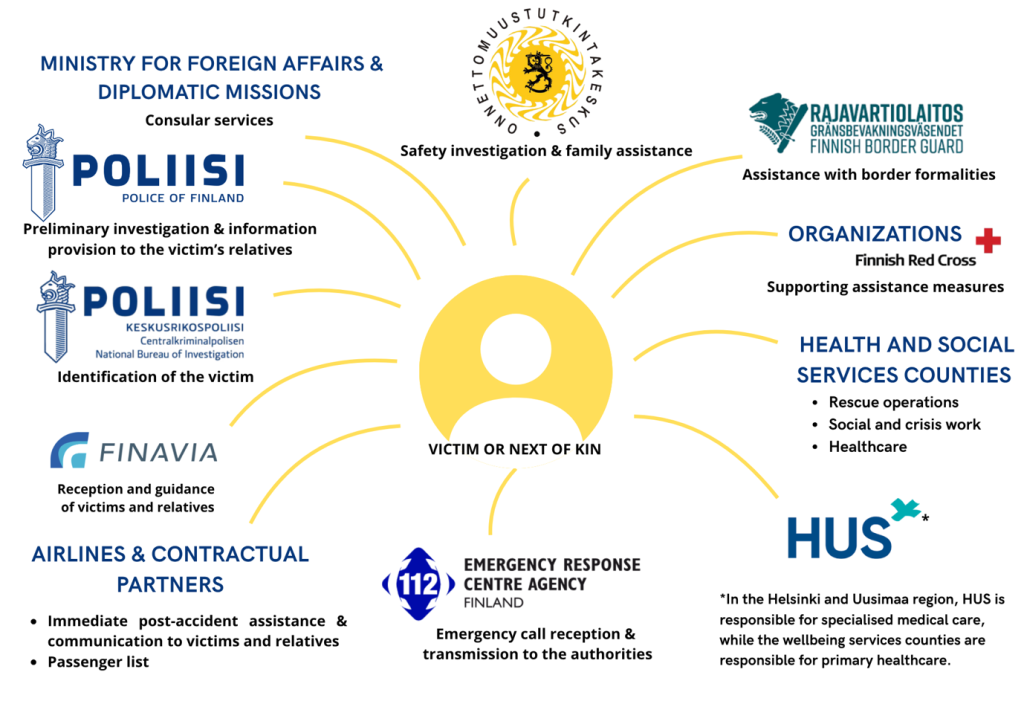
Parties involved in family assistance activities.
Head of Public Affairs
0295 150 714
firstname.lastname@om.fi