
Grounding of M/S Ejdern in Torsholma, Åland, 6 October 2023
13.12.2023
06.10.2023
13.12.2023
Marine (M)
M2023-E3
Accident
Sequence of events
On 6 October 2023, around 19.30 (UTC+3), when MS Ejdern was to dock at Lilla Hummelholm ferry quay in Torsholma, it encountered problems due to bad weather. Prior to arrival, the deckhand went down from the bridge to run down the aft ramp to let 5 passengers and 3 vehicles ashore. The engine officer was in the engine control room and the master was alone on the bridge manoeuvring the vessel. The wind direction during the manoeuvre was south-easterly and the wind speed was estimated to be in excess of 20 metres per second. It was dark and the rain was pouring down. The figure 1. below main timings and positions during the sequence of events.
The blue line (fig. 1) shows the first docking attempt at approximately 19.29 (1). The vessel almost reached the quay, but the bow thruster could not hold it and the wind and possibly the current pushed the vessel outwards. A new attempt was made, stern first, which was also unsuccessful. After this, the master tried unsuccessfully again to go bow first. A third attempt was made to go in stern first – without success. After this the master called up the engine officer and asked him to switch on the so-called constant revolutions engine control mode, but this did not help either in berthing. After this, the master decided to go to Lappo and manoeuvred south for about 200 metres. At that point, the vessel was floating without propulsion from approximately 19.49 (2) and drifted approximately 270 metres towards north-west before finally running aground at 19.55 (3). At approximately 21.15 the vessel became loose, because the wind direction had changed, and drifted about 200 metres towards north-east. The master decided to anchor, and the anchoring was completed at 21.21 (4). At 21.45 two coast guard officers came on board and gave a breath test to the crew, which showed a blood alcohol level of 0. After inspecting the vessel and confirming that propulsion and machinery were functioning and no leaks were detected, and after having received permission from Traficom (the Transport and Communication Authority) and the classification company Lloyds, the master decided to lift anchor and proceed to Lappo at 22.29. The vessel finally docked in Lappo at 23.06. The Finnish Border Guard Vessel Tursas, a patrol boat from the Kökar border guard station, a patrol boat from the Susiluoto border guard station and two vessels from the Åland Lifeboat Society, Lady from Brändö and Stormskär from Vårdö, ensured a safe transit to Lappo.
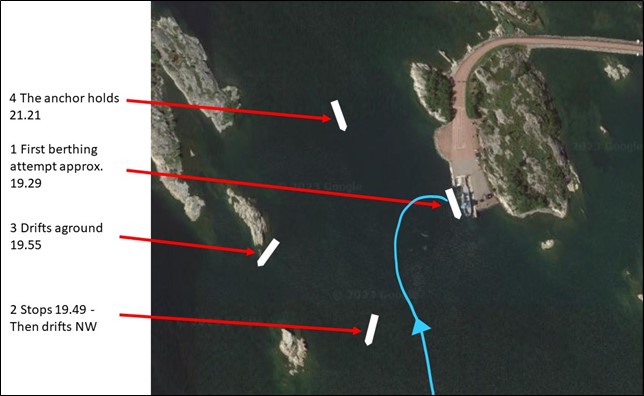
Figure 1. Positions and timings according to ECDIS during the sequence of events (Illustration: SIAF)
Background factors
The main alarming related issues are described below:
- 19.55 MS Ejdern runs aground, after which the deckhand calls the Fleet Manager’s emergency number.
- 20.03 Fleet Manager contacts the Alarm Centre in Mariehamn for onward connection to the MRCC (Maritime Rescue Coordination Centre). The shipping company’s internal communication and communication with the Åland Government are initiated.
- 20.08 MRCC commences the sea rescue incident and sends alarms to units at 20.10.
- 20.15 The master notifies the shipping company’s DPA (Designated person ashore).
MS Ejdern is a local ferry (so-called landskapsfärja) operating the route Torsholma-Lappo-Asterholma-Kumlinge-Enklinge and has a crew of three consisting of master, engine officer and deckhand. Nordic Jetline Finland Ltd, by agreement with the Åland Government, have operated the vessel since 1.9.2019 and since 1.9.2023 have been the registered owner. The agreement period is four years with a possible extension of one year.
Nordic Jetline Finland Ltd is one of several shipping companies with the same owner which handle ferry traffic on a number of routes, including in Åland. MS Ejdern is, however, the only ferry in Åland that is operated by Nordic Jetline Finland Ltd. The ferry was built in Turku by Laivateollisuus Ab and was completed in 1978. According to its certification, it has a length of 40.08 metres a beam of 9.50 metres and a draught of 3.90 metres. MS Ejdern can carry a maximum of 99 passengers. The main engine power output is 1258 kW and the ferry has a left-hand adjustable propeller and bow thruster. The left-hand propeller means that the vessel’s stern pulls to the left when reversing hard. The bow thruster is driven hydraulically, and the power output depends on the operating power of the main engine. The main engine can be operated in two modes. It normally runs in so-called combination mode, in which the power of the main engine and the propeller blade pitch follow a preprogramed curve. In the other mode, the main engine runs at a high constant revolutions and only the pitch of the propeller blade is changed. The latter also gives full power output for the bow thruster. This mode is often used in bad weather and is known as manoeuvring at constant revolutions.
The bridge layout of MS Ejdern is shown below (Figure2). The master normally navigates on the starboard side. As well as radar, there is a main screen with keypad for the ECDIS (Electric Chart Display and Information System). The ECDIS has two slave screens on either side of the bridge as well as a further radar screen on the port side. The unit to change from combination to constant revolutions is only on the starboard side of the bridge.
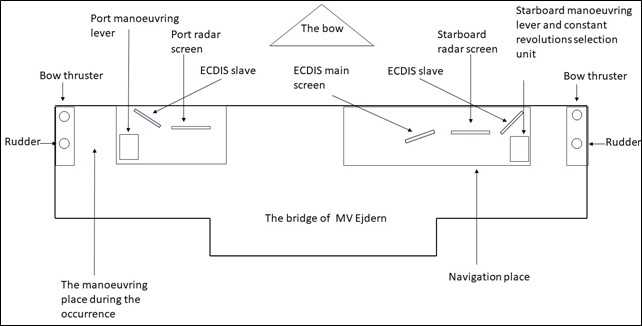
Figure 2. Bridge layout of MS Ejdern (Sketch for illustration, not to scale, illustration: SIAF)
MS Ejdern has a fixed timetable. However, it also takes into account any emerging traffic needs made by customers. These emerging traffic needs can be communicated via Ålandstrafiken or by telephone direct to the vessel. For example, a Friday sailing list with winter timetable can start at 06.45 from Lappo and end at 23.30 in Asterholma. The daily operation period includes the crew’s rest periods.
The shipping company has an approved Safety Management System (SMS). According to the SMS, emergency alarms are given from the vessel direct to MRCC. This was not done in the case at hand. SMS also states that a newly employed master must have a 1–3-day introduction, depending on his/her experience of similar vessels. The master of MS Ejdern had undergone a two-day introduction. After this, the master had been on duty for approximately 8 days prior to the incident. The vessel’s and shipping company’s SMS say nothing about wind restrictions.
Observations
MS Ejdern sailed from Kumlinge to Torsholma on Friday 6 October 2023 in increasingly windy weather. During the day, the master, shipping company and Åland government had discussed and decided on cancelling Saturday’s sailings because of strong winds.
Coastal Åland traffic is important for the transport of people and goods and sailings are rarely cancelled, which means that the crew on board try to get to the ports of call, sometimes in difficult conditions. According to MS Ejdern’s operating agreement, there is no financial disadvantage to cancelling sailings. Nor does the agreement include any wind restrictions. The master assesses the situation and has the right of final decision concerning the safety of the vessel – which is standard practice in the shipping industry. Even though the master is under no formal pressure from the Åland Government or the shipping company, a master can still experience external pressure to operate from passengers, relatives ashore or colleagues for example regardless of the weather.
There was strong wind and heavy rain when MS Ejdern was approaching Torsholma. The master made last attempt to berth by using constant revolutions, but without success. He made no special settings of the radar or ECDIS before the port manoeuvre. The port was lit up and manoeuvring in the ports is normally done visually.
MS Ejdern has a relatively small crew, which means that during docking manoeuvres the master is alone on the bridge, the engine officer is normally in the engine control room and the deckhand on deck operating bow or stern ramp.
Manoeuvring in rough weather is demanding. These situations demand a good knowledge of the vessel’s manoeuvring capabilities, as well as knowledge of the technical aids that improve the vessel’s manoeuvring performance.
The preliminary investigation indicates that the master had a two-day introduction before taking up his duty. Introductions are normally performed with the aid of checklists where safety, equipment and technology are covered. Exercising manoeuvring in rough weather is important, however not always possible during the introductory period and is handled as on-the-job training. It is known that currents can make manoeuvring to the quay at the port of Torsholma difficult.
Emergency anchoring of MS Ejdern was successful but not entirely problem free. The anchor winch was not ready for emergency anchoring. It is important that all safety equipment can be used immediately when situations arise.
The Safety Investigation Authority, Finland does not initiate a safety investigation into this incident but emphasises the importance of:
- Adequate and sufficiently comprehensive introduction for new crew members on the vessel’s capabilities and its sailing routes.
- A small crew’s capability to handle all emergency situations.