
Assessment report: Accident at the Kotka PowerBoat Race on 1 August 2026
09.10.2026
01.08.2026
09.10.2026
Marine (M)
Accident
Course of events
In the GT30 class powerboat race driven off Kotka Kantasatama harbour on 1 August 2026, an accident occurred in which a young driver was fatally injured. The accident occurred when a racing boat made a sudden turn in front of another racing boat. The driver of the latter did not have time to react to the sudden turn of the preceding boat and drove over it.
Before the accident, two racing boats were approaching the third turn of the circuit, where the racing line turns sharply to the left (Figure 1, buoy 3). One of the boats was on an outer racing line, slightly ahead of the other boat.
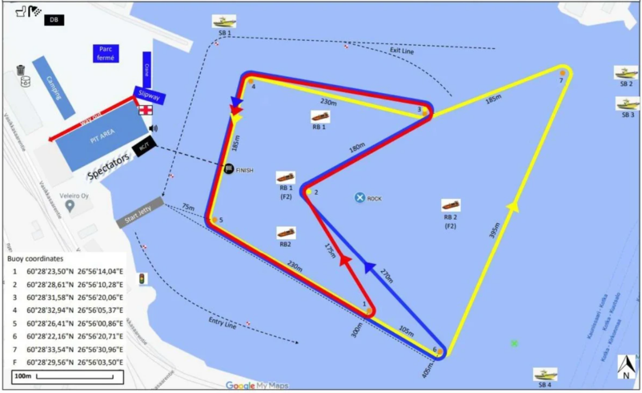
Figure 1. Racing lines of the Kotka PowerBoat Race. The GT30 class racing line is marked in blue. The accident occurred at buoy number 3. (Photo: Finnish Sailing and Boating Federation / OTKES (marking))
Shortly before the turn at the buoy, the boat that had driven on the outer line suddenly turned in front of the racing boat that had raced on the inner line (Figure 2). The driver of the turning boat had lost control of his boat, and the boat lost its speed in front of the boat coming behind. There was only about one second of time to react before the collision. The driver of the boat coming behind tried to steer his boat to the right but could not prevent the collision. The speed of the boat was estimated at approximately 80 km/h. Its course ran directly across the other racing boat that had stopped on its way sideways. The boat that ran over it. The impact spot was at the level of the cab (Figure 3). The driver’s helmet came off his head in the collision.
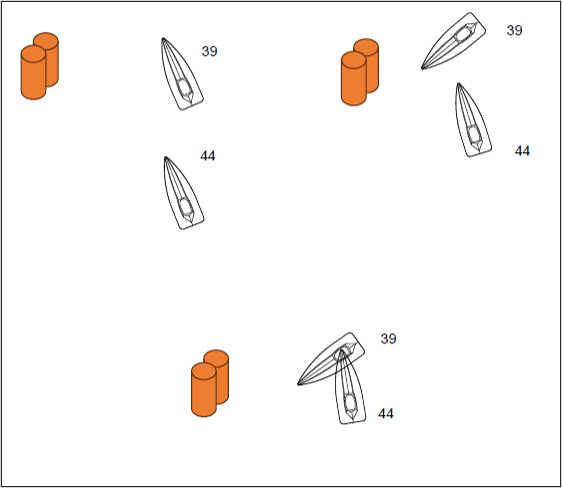
Figure 2. Illustrations of the accident situation (drawing: UIM, Mandatory Standard Accident Report)
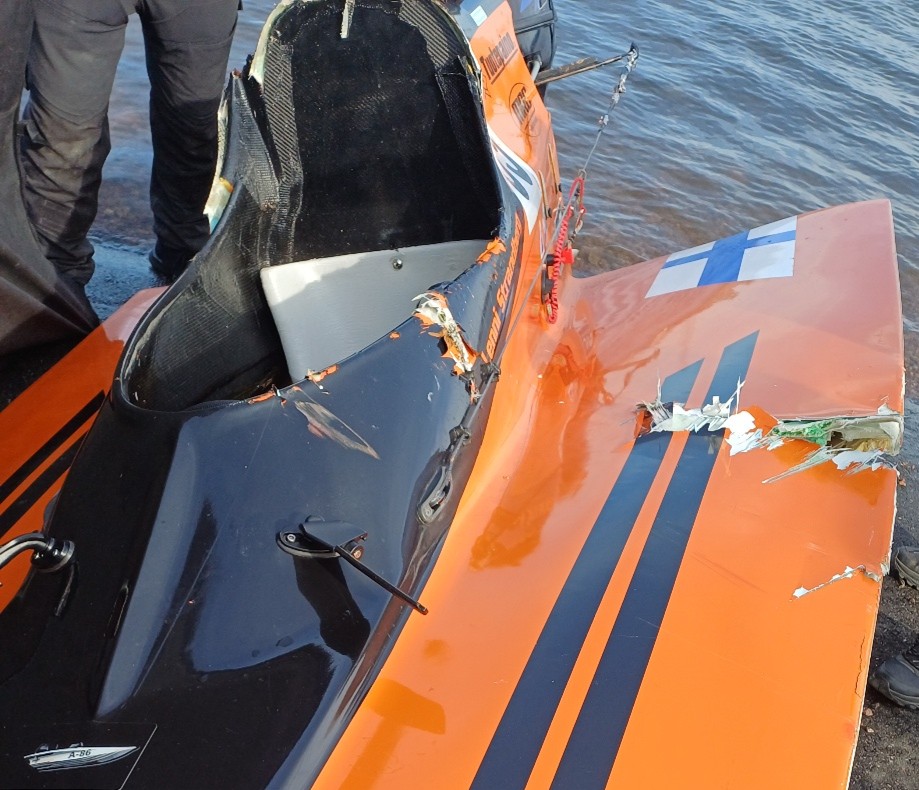
Figure 3. Marks of the collision on boat no. 39. (Photo: Police)
The reason behind the sudden turn and the loss of control may have been either a sharp steering manoeuvre or a wave hitting the boat. Situations like these may make the boat’s stern lift out of the water. When a fast-moving boat returns to the water, it may suddenly change direction and stop if the hull is not straight in relation to the direction of travel. This subjects the boat to a strong braking force (fluid friction). In the field, such an incident is called hooking, i.e. the boat digs into the water. The high speed of the boat, wave action and a turned rudder enhance the turning effect of fluid friction. A sudden stop also often subjects the driver to high G-forces, which may temporarily affect their ability to act.
The safety boats spotted the crash immediately and the first one of them reached the collision site in 20–30 seconds following the crash. As the injured driver could not be immediately removed from the boat, the boat was quickly towed to the shore where resuscitation of the driver was initiated. However, with no result, the resuscitation efforts were stopped, and the driver was declared dead at the scene.
Background information
The GT15 World Championship, the GT30 European Championship and the GT10 European Cup were due to be decided together at the same event in Kotka, Finland, between 31 July to 2 August 2026. The Finnish Sailing and Boating Federation was responsible for organising all these races. The GT classes are governed by the international governing body of powerboating UIM (Union Internationale Motonautique). UIM determines the racing rules and guides requirements posed on safety as well.
The Kotka PowerBoat Race was a public event, and the police, the rescue department and Traficom had been notified of it. A head of safety had been appointed for the race. An ambulance was present throughout the event. The access to the water area was restricted for the duration of the race to keep the racing action separated from other waterborne traffic. The public mainly followed the race from the dock of the Kantasatama harbour. Safety boats, with a diver standing by, were posted on the race area to ensure the safety of the racers.
During the race, the weather was good, and there were no wind-generated waves in the competition area. However, during the race, the boats generated slight waves on the race circuit, which made the boats bounce every now and then.
The safety of boat racing is ensured through regulations and inspections. The technical requirements specified by UIM apply to boat structures, engines, equipment and the driver’s safety equipment. When designing and manufacturing race boats, the aim is to maximise the properties that are favourable for racing. The driving characteristics of race boats are a compromise between straight line speed and manoeuvrability. The GT30 class boats usually drive straight circuit sections and in calm waters so that the only part of the boat in contact with water is the section below the propeller shaft. The maximum speed of the boat is approximately 87 km/h, which can be reached on the straight sections of the race circuit.
Safety observations
When participating in speed racing with boats, drivers take conscious risks. In the GT30 class, drivers are typically 16 to 18 years old. In Finland, children as young as 7 can start racing. The ability of children and young people to identify risks or regulate their actions in accordance with the level of risk has not yet fully developed, so the safety of boat racing depends on the rules and practices created by adults, and the accepted level of risk.
A risk that is well known in the field of racing – a boat hooks and suddenly turns in front of another boat – materialised in the accident that occurred at the Kotka PowerBoat Race. The higher the speed, the greater the risk of a hook, as the boat’s stability deteriorates with increasing speed.
The key safety observation made concerns the general conception of risks in the field: Minor incidents occur frequently in racing events, such as boats capsizing and people getting injured. Those involved in racing consider these incidents as part of the sport. Since serious accidents rarely occur, boat speed racing is considered a safe sport. However, the actual indicator of the safety level of a high-risk racing activity is not the number of serious accidents, but the number of smaller incidents, hazardous situations and near misses. Accidents are the tip of the iceberg, so attention should be paid to these smaller incidents.
During the assessment, the amount of driver training among the boat drivers emerged an issue. During the past summer, the amount of driver training received by the drivers had been relatively small. Many of them practise alone in the vicinity of their home jetty, which means that they gain limited experience of different driving situations and weather conditions. High-risk situations, such as driving in waves, sharp turns and driving near other boats, are not taken into account in the training. Versatile driving training and the identification of risks promote safety in racing situations.
After assessing the incident, the Safety Investigation Authority decided not to initiate a safety investigation into the marine casualty. It estimated that a safety investigation would not provide significant additional information that would lead to substantial safety improvements.
Ms. Mirva Salokorpi
Chief Safety Investigator,
Marine
02951 50730
firstname.lastname@om.fi