
Report on the derailment of a railwaymaintenance machine in Tornio on 17 December 2025
16.02.2026
17.12.2025
16.02.2026
Railroad (R)
R2025-E2
Incident
The Safety Investigation Authority, Finland (SIAF) assessed the derailment of the Tka8 railway maintenance machine on track 741 that occurred in Tornio on 17 December 2025 at 12.11. In the accident, the railway maintenance machine derailed at the Opastinkatu Kolmio level crossing.
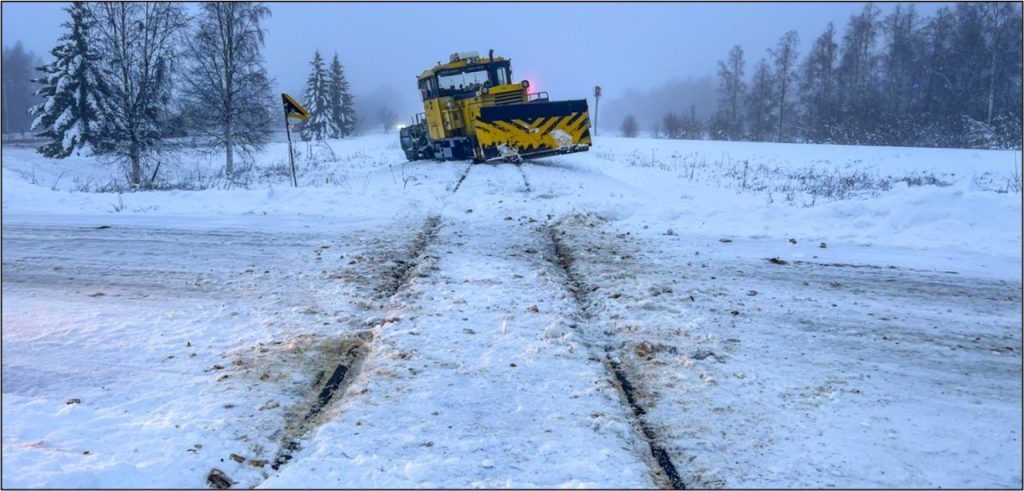
Figure 1. The derailed Tka8 railway maintenance machine to the north of the level crossing. Track 742, used for traffic between Kemi and Kolari, is on the right side of the photo. (Photo: Safety Investigation Authority)
After the machine stopped, the driver reported the incident to the rail traffic control. A mobile crane was ordered to lift the machine back onto the track. The machine was re-railed on 18 December after 6.30 p.m. After this, it was moved from the derailment site to the Tornio station railway yard.
The derailment did not cause any personal injury. Damage to the railway maintenance machine was also minor. Several railway sleepers were damaged on the track. The accident did not cause significant traffic disruptions, as track 741 is very lightly used, and the derailment did not affect the traffic on the adjacent track 742 used for traffic between Kemi and Kolari.
BACKGROUND INFORMATION
It was observed that the flangeways at the level crossing were filled with ice and sand. As a result, as the maintenance machine arrived at the level crossing, its wheel flanges lifted out of the flangeways, and the machine was derailed.
Opastinkatu is a street used as a route for special transports. It allows transports to circumvent the low underpasses in the area. Due to heavy traffic, the street is ploughed and sanded regularly. The purpose of the rubber flangeway fillers at the edge of the timber level crossing deck is to prevent the flangeways from filling with sand and snow. The rubber flangeway fillers at the level crossing were found to be partly in poor condition, which had contributed to the grooves getting filled. As temperatures fluctuate around freezing, snow and sand are prone to freeze into the flangeways, forming a very hard layer, as was now the case.
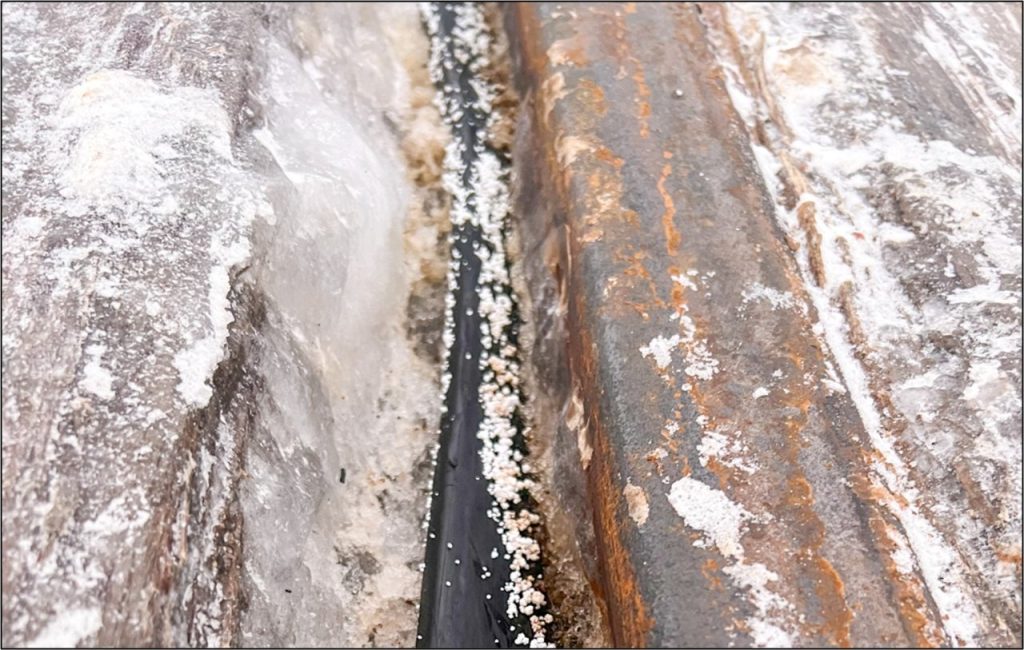
Figure 2. Ice build-up in the flangeway. (Photo: Safety Investigation Authority)
It is very difficult to clean the flangeways mechanically during snow clearance on the track, especially if ice is forming on them. To clean the flangeway, a sweeper is typically used, and its mechanical brushes remove snow and other dirt from the flangeways. However, when flangeways are completely blocked by ice, mechanical cleaning often provides the only option. In the Finnish Transport Infrastructure Agency’s guidelines, cleaning of flangeways and maintaining rubber flangeway fillers have been defined as part of track maintenance tasks. Challenging weather conditions and rubber flangeway fillers in poor condition generally increase the need for the winter maintenance of level crossings.
The low axle load of rolling stock at level crossings also increases the risk of the derailment of rolling stock in situations where the flangeways are blocked, as the weight of rolling stock is insufficient to break ice from the flangeways.
OBSERVATIONS
Derailments caused by the filling of flangeways are typical in winter, especially at level crossings and industrial tracks. Derailing rolling stock is often relatively light, mostly unloaded freight wagons. It is very difficult for the driver or shunting foreman of rolling stock approaching a level crossing to see the condition of the flangeways before the level crossing.
In Finland’s mostly single-track rail network, derailments often cause extensive, long-term traffic disruptions. In the prevention of derailments, the winter maintenance of the flangeways and the condition of rubber flangeway fillers play a major role.
It is also important for rolling stock drivers and shunting foremen to acknowledge the risk of derailment caused by the filling of flangeways when operating in areas with grooved rails.
The assessment found that a safety investigation conducted by the Safety Investigation Authority would not provide significant additional information that would lead to substantial safety improvements. The Safety Investigation Authority, Finland (SIAF) will not initiate a safety investigation into the incident.