
Fatal accident in Ouluvesi in Ähtäri 14 March 2025
23.07.2025
14.03.2025
23.07.2025
Marine (M)
Accident
The Safety Investigation Authority, Finland conducted a preliminary investigation on an accident that took place in Ouluvesi, Ähtäri, on 14 March 2025. Two people died after falling through the ice on a snowmobile despite the rescue operation.
Course of events
The emergency call was made by a person who saw some kind of mass on the ice of the lake and heard cries for help. At 5:36 p.m. The Emergency Response Centre alerted the fire officer on duty in Seinäjoki and the units from the rescue station in Ähtäri. At the time of the accident air temperature was -12 degrees Celsius and the wind in the area was strong. Ice thickness at the accident site was approximately 20 millimeters.
The duty fire officer led the task remotely at first with the help of the rescue vehicle’s video system and telephones as the journey to the accident site would have taken more than an hour. The first units of the Ähtäri rescue station arrived in the area approximately 15 minutes after the call . The rescue unit started the rescue operation on the shore approximately 300 metres from the site of the accident. The site was in the middle of Kaijanniemi narrows in Ouluvesi.
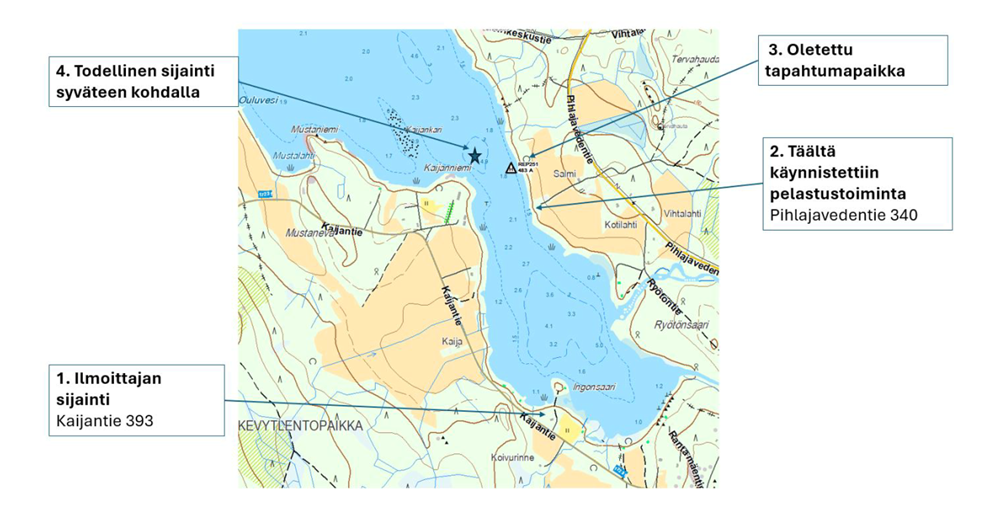
Point 1. Position of the observer. Point 2. Position where rescue operations commenced. Point 3. Assumed accident site. Point 4. Actual accident site.
The rescue operation conducted with a rescue swimmer and a hovercraft. While the hovercraft was being prepared the rescue swimmer made an urgent effort on ice by foot towards the accident site and the victim. As the rescue swimmer approached the accident site ice broke beneath him about 20 metres before reaching the victim. At this phase hovercraft approaching the site reached the rescue swimmer and picked him up. Distance from the shore to the accident site was approximately 300-350 meters.
When arrived at the accident site the rescue swimmer jumped into the water to assist the hovercraft operator to lift the victim onto the hovercraft. During the lifting operation the hovercraft engine had to be unbutton that resulted the lost of hovering and the hovercraft landed to the water. While lifting the hovercraft took in a lot of water. During the operation it was found also that there was another victim underwater who was presumed dead.
After getting the first victim on board the hovercraft operator tried to take the victim to the shore, but the engine stopped after 15 meters ride and the hovercraft landed on the water. The operator started to bail the water on the bottom of the vessel and tried to start the engine without success. At this point, the hovercraft suddenly tilted and capsized to the left side ending upside down in the water. The operator managed to get onto the bottom of the vessel holding the victim and waiting for the rescuers.
At the same time rescue swimmer was heading back to the shore by foot to get a surface rescue board. The rescue board was to be used to get the other victim from underwater to the shore. At this phase more rescue units had arrived at shore to assist in the operation. Hypothermic rescue swimmer reached the shore and was taken into the warm premises. The hovercraft operator managed to get to the shore by himself.
Eventually both victims managed to take to the shore by the assistance of additional rescue units about in an hour after the alert. Emergency medical service units took care of the victims and confirmed both dead.
A Border Guard rescue helicopter had also been alerted to the scene, but it was late to participate in rescue operation. After the operation a defusing session was organised for those participating in the rescue operation. The capsized hovercraft and snowmobile were lifted out of the water on the following day for further examination.
Background information
In South Ostrobothnia the rescue department of the wellbeing services county produces rescue services in the region. There are 31 Rescue stations in the region of which Seinäjoki and Lapua stations have personnel in 24/7 readiness. Rest of the stations are manned by the permanent personnel of South Ostrobothnia Rescue Service together with parttime rescuers during the office hours on working days. In South Ostrobothnia district distances are long and the closest rescue unit consist of part time rescuers in many cases.
The Oulunjärvi lake ice situation was poor, and part of the area was free of ice. At the accident scene, the load-bearing capacity of the ice varied greatly. The ice conditions were similar to the thawing period in the spring and autumn.
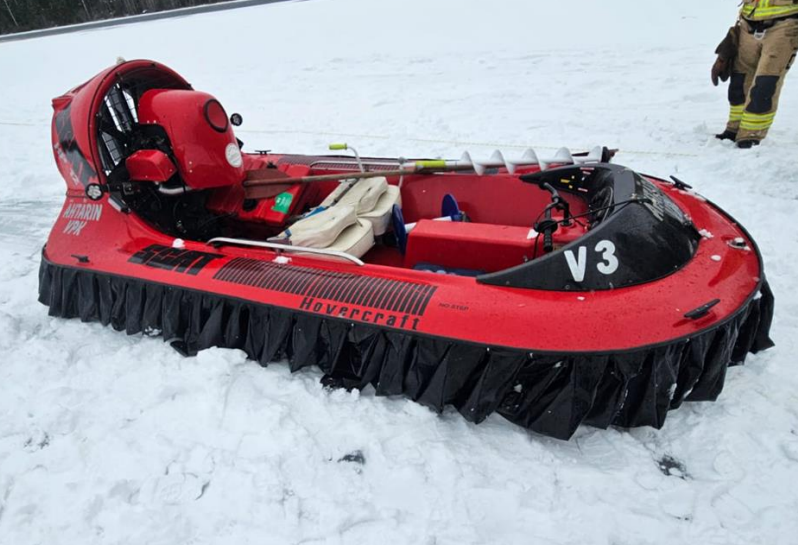
The hovercraft of the Ähtäri rescue station is a Scat Hovercraft hp 12 model and it has been commissioned in 1991. It is a single-engine model, and it has been reported by the manufacturer to have a maximum loading capacity of approximately 340 kilos. The skirts affecting the hovering of the hovercraft had been repaired with cable ties that has a negative effect on the vessel’s hovering capability. To unbutton the engine of a hovercraft will cause it to land. The hovercraft engine was known to be susceptible to technical problems, but the root cause to stop engine remained unknown.
Ähtäri rescue unit members communication with other units and the and the head of rescue operations is based on Virve phones (Authorities’ communication system). The number of the phones is limited which affected the compilation of a coherent situational picture that is important for the rescue operation management. The phone in the hovercraft was to be carried on the bottom where it was vulnerable for water ingress. Rescuer swimmers’ suits did not allow to carry the phones during the task.
Observations
The 24/7 response readiness of South Ostrobothnia Rescue Department is widely based on parttime rescue units. In the area are only two Rescue stations with 24/7 hour readiness and manned with permanent personnel.
South Ostrobothnia Rescue Service owns all material used in rescue operations. This means that also the maintenance is on it’s responsibility. If there are any exceptions on this regarding the the rescue material it will be agreed separately between the parties. The hovercraft in question has been purchased well before the current organisation so there was no information about possible maintenance responsibilities.
The ice situation at the scene of the accident was poor, due to the season and the water flow from power plant in the vicinity of the site. Ice situation complicated and slowed down surface rescue measures significantly.
Firstly the descent on the water surface of the hovercraft for lifting the victim, secondly the large amount of water ingress to the vessel and lastly the weight of the victim affected the stability of the vessel. The potential stability risk based on these factors was not known to the operators. The operators did not identify the risk posed by the free water surface to the stability of the vessel, which was a probable cause of the capsizing of the vessel.
Rescuer swimmers were not able to carry a phone with them during the operation, which hindered the compilation of a coherent situational picture. This hampered the management of the operation.
The South Ostrobothnia Rescue Department will conduct an internal investigation of the accident. The occupational safety and health authority and the police will also investigate the accident. The Ministry of the Interior’s Department for Rescue Services has also initiated an investigation into the case.
The Safety Investigation Authority, Finland (SIAF) will not initiate a safety investigation into the occurrence. The assessment found that a safety investigation would not provide significant additional information nor safety benefit that would lead to substantial safety improvements.